








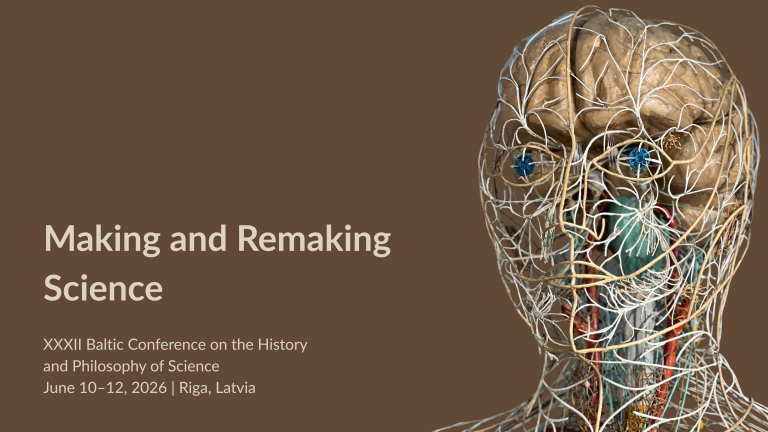
Making and Remaking Science
XXXII Baltic Conference on the History and Philosophy of Science
June 10–12, 2026 | Riga, Latvia
The 2026 Baltic Conference on the History and Philosophy of Science explores how science has been made, remade, and transformed in the Baltics across different political regimes and historical periods. While the post–Second World War restructuring of science under Soviet rule forms an important focus of the conference, the theme also invites contributions addressing earlier and later periods, examining the shifting nature of scientific cultures over time, as well as offering comparative perspectives from the wider Baltic Sea region, including the Nordic countries. We particularly welcome contributions that examine how scientific knowledge, practices, and scientific communities have been reshaped through political change, institutional reorganization, and shifting ideological frameworks. The conference invites papers offering historical and philosophical perspectives on the natural sciences, medicine, applied sciences, and the humanities
Registration
Authors who submitted abstracts have already received individual instructions on how to proceed with registration.
Keynote speakers
- About the speaker
Dr. Jost Eickmeyer holds a PhD in Literary Studies from Heidelberg University; he worked at Universities at Heidelberg, Berlin (FU), Hamburg, and Rostock. Since 2023, he has been head of the Research Center for the History of Travel Culture (Forschungsstelle zur historischen Reisekultur) at the Eutin State Library, which is dedicated to the study of historical travel literature. He is also editor of the academic periodical on travel culture IN VIA. Zeitschrift für historische Reisekulturforschung.
- A Philosopher’s Travels or A Traveler’s Philosophy? On the Globetrotting and Knowledge-Making of Hermann Graf Keyserling
The relation between travel and the acquisition of knowledge has been well established for a long time in the cultural history of Europe. As early as in the course of the 16th century “it became a communis opinion among intellectuals that travelling was an important means of acquiring knowledge and experience, and that an extended tour abroad was a vital, if not indispensable part of humanist, academic and political education” (Enenkel/De Jong). With the transport revolution of the 19th century the already astonishing distances covered by travelers and explorers on land and sea became ever more manageable, with steam boats outmaneuvering the “aeolian” clippers on the Oceans, and in particular locomotives and trains “annihilating” space and time of land travel in previously unfathomable ways (Schivelbusch). Traveling ‘around the world’ – as epitomized in Jules Verne’s first leisure-globetrotter Phileas Fogg from 1872 – became an option, an aspiration, and no less a means of seeing and experiencing the most distant lands an cultures in a comparably short period of time (cf. Staszak/Pieroni).
In 1919, tellingly the same year which saw the first German movie adaptation of Verne’s novel Around the world in 80 Days (by Richard Oswald), another account of a Globetrotter was published in print: A Philosopher’s Travel Diary by the Pernau born count Hermann von Keyserling. In the years 1910 and 1911, Keyserling had, in his early thirties, started out from Livonia via the Mediterranean, Africa, Egypt, on towards India and the Himalayas to China and onwards via Japan and Hawai’i to the United States from where he returned by ship to Europe. His travel diary was an immediate success with the public seeing no less than five new editions until 1927. It founded his fame as a traveling philosopher, a wise man, well-versed in the world, the founder of a “School of Wisdom” [Schule der Weisheit] in Darmstadt in 1920 and of the explicitly un-academic “Society for a Free Philosophy” [Gesellschaft für freie Philosophie]. Thus, he became one of the most notorious – and from the perspective of university Scholars: contested – public figures of the Weimar Republic.
In my talk I will try to elaborate on the connection of travel writing, philosophy (as practice), and “Weltanschauung” in Keyserling’s most famous book, risking a few sidesteps into some of his later works on Europe (Das Spektrum Europas, 1928) and America (Amerika. Der Aufgang einer neuen Welt, 1930). Key questions may be: How do traveling the world and philosophy as a way of (maybe) meditating on the world intersect or compete with each other in Keyserling’s diary? How does Keyserling himself perform the relation of cultural contact (during travel) and knowledge-making (as a writer)?
References
Enenkel, Karl A.E. / de Jong, Jan L. (eds.), Artes Apodemicae and Early Modern Travel Culture, 1550–1700. Leiden; Boston: Brill 2019 (Intersections, 64).
Schivelbusch, Wolfgang, The Railway Journey: Trains and Travel in the 19th Century. Translated from German by Anselm Hollo. New York: Urizen 1979.
Staszak, Jean-François / Pieroni, Raphaël (eds.), La Manie des tours du monde. De Jules Verne aux premiers Globetrotters. Paris: Lienhart 2025.
- About the speaker
Dr. Karl Johannes Lierfeld (*1977) is a multifaceted entrepreneur, author, and scholar specializing in artificial intelligence, neuroscience, and space technology. Holding a doctorate from the University of Cologne and having defended a second PhD thesis in neuroscience and philosophy at Ludwig Maximilian University of Munich, his neuroscientific research focuses on the “Conversion Theory" and brain-computer interfaces. In 2024, he founded the 3D printing startup HABITATO/LUNAR HABITATO, which manages patented space tech designs such as the "Matryoshka Shell Design" and collaborates with the European Space Agency (ESA). His extensive publication record includes works on AI ethics, artificial superintelligence and the implications of brain-computer interfaces for neuroscience. Additionally, Lierfeld is active in numerous scientific and voluntary organizations, including the German AI Association, Rotary International, and the BCI Society.
- From Consciousness Theory to Space Tech: AI as a Scientific Enabler
The advent of artificial intelligence (AI) marks a landmark turning point in human history: for the first time, technological progress is quicker than our adoption rate of said technology. In other words: we struggle to keep up with the momentum and dynamics this branch of innovations offers us. Hence, this presentation explores a burgeoning paradigm shift in scientific inquiry, where AI serves as the pivotal tool for navigating complex theoretical frameworks as presented in neuroscience, high-stakes engineering challenges as posed by space tech or data-heavy research areas as in medicine. By utilizing AI as a scientific enabler, researchers can decouple the traditional relationship between research depth and time. Through AI-accelerated R&D and agile iteration cycles, an ever-increasing depth of understanding can be achieved in ever-decreasing timeframes, facilitating breakthroughs by validating assumptions early and bypassing costly trial-and-error routines. The transformative power of this approach is demonstrated through two distinct fields of research led by Dr. Johannes Lierfeld:
• The Conversion Theory of Consciousness: This theoretical framework addresses the "qualia problem" by proposing a process dualism. It suggests that consciousness emerges from the irreversible conversion of objective sensory data into subjective phenomenology. AI and brain-computer interfaces serve as essential lenses for modeling these conversion stages and understanding neurological conditions like Capgras or Fregoli delusions, where the "emotional tagging" or "contextual integration" of data fails.
• LUNAR HABITATO: Translating high-level theory into space technology, this project utilizes AI-driven feasibility simulations and digital twins to develop a permanent, ISRU-driven (In-Situ Resource Utilization) moon habitat. By leveraging AI agents and XR/VR/AR simulations, the project de-risks complex construction challenges - such as the patented Matryoshka Shell (MaSh) design - to achieve 95% local material usage and significant cost reductions. Implementation of AI-supported research is also a major step towards de-risking, for instance by running AI-driven feasibility simulations in XR/VR/AR. But although the implications for the medical sector are immense, the success of this paradigm relies heavily on data quality management to ensure valid results. As AI tools evolve rapidly, the primary challenge shifts from the sheer technological possibilities to our capacity to utilize these tools strategically to foster scientific breakthroughs. Only if we adapt quickly and adequately, we can unlock the full potential of AI as a scientific enabler.

- About the speaker
Marianna Muravyeva is a Professor of Russian Law and Administration at the University of Helsinki. Her research is interdisciplinary bringing together history, social sciences and law to examine long-term trends and patterns in social development with a special focus on normativity, gender and violence. Some of her most recent projects focus on human rights of women, conservative jurisprudence, violence against women, and family violence (violence against parents and domestic violence). Professor Muravyeva co-chairs Women and Gender Network of the European Social Sciences History Conference. She has published extensively, including a recent book Parricide and Violence against Parents: A Cross-Cultural View across the Past and Present (London, New York: Routledge, 2021); edited volumes Domestic Disturbances, Patriarchal Values: Violence, Family and Sexuality in Early Modern Europe (New York: Routledge, 2015); Women’s History in Russia: (Re)Establishing the Field (Cambridge: Cambridge Scholars Publishing, 2014); Gender in Late medieval and Early Modern Europe (London and New York: Routledge, 2013) and numerous articles and books chapters.
- Knowing the Family: Science, Law, and the Governance of Intimacy
This paper examines how the family emerged as a key object of scientific and administrative knowledge in modern societies. From the late nineteenth century onward, scholars and practitioners across law, medicine, criminology, statistics, and emerging social sciences increasingly treated the family as a domain that could be observed, classified, and governed through systematic forms of expertise. In this process, intimate life became a crucial site for the production of knowledge about social order, deviance, and population management.
The paper situates the regulation of family life within broader histories of knowledge-making, highlighting how legal doctrine, demographic statistics, and criminological research functioned as epistemic tools through which states sought to understand and shape society. By tracing transformations across imperial, Soviet, and post-socialist contexts, the talk explores how changing political regimes reshaped both the institutions and epistemic frameworks through which family life was studied and governed.
Framing family history as a history of knowledge production, the keynote argues that the family operated as an epistemic laboratory in which scientific authority, legal norms, and political power intersected. Examining these dynamics illuminates how expertise about intimacy has been continuously made and remade, revealing the entanglement of science, governance, and everyday life.
Organizers
- Latvian Association of the History of Science
- Latvian Academy of Sciences
- Institute of the History of Medicine, Faculty of Medicine, Riga Stradins University
- Research Center for Engineering History, Riga Technical University
- Interdisciplinary Center for German Studies Riga, Faculty of Humanities, University of Latvia
- In cooperation with the project Forgotten Philosophers: Erika Sehl and Kurt Stavenhagen at the Herder-Institute in Riga and in the World (LZP-2023/1-0216)
Conference administration: Association for the Support of Medical Museums
Organising Committee: Dr. habil. paed. Tatjana Koķe, Dr. med. Juris Salaks, Dr. phil. Raivis Bičevskis, Dr. paed. Alīda Zigmunde, Dr. sc. ing. Ilze Gudro, Artis Ērglis, Kaspars Zaltāns, Anna Atvara, Dr. med. Ieva Lībiete
Contact:
Ieva Lībiete
Executive Secretary of the Organizing Committee
Email: ieva[pnkts]libiete rsu[pnkts]lv


Supporters:

Location
Tā kā Rīgas Stradiņa universitāte ir publiska iestāde, pasākuma laikā jūs varat tikt fotografēts un/ vai filmēts. Fotogrāfijas un video var tikt publicēts universitātes mājaslapā, sociālajos medijos u. tml. Vairāk par savām tiesībām un iespēju iebilst pret šādu datu apstrādi varat uzzināt RSU Privātuma politikā. Ja iebilstat pret personas datu apstrādi, lūdzam par to informēt, rakstot uz rsursu[pnkts]lv (rsu[at]rsu[dot]lv).
As Rīga Stradiņš University (RSU) is a public institution you could be photographed and/or filmed during the event. Your personal data might be used to further the interests of RSU, e.g. for marketing or communication activities (incl. social media coverage). Read more about your rights see the RSU Privacy Policy. Should you have any objections to your personal data being processed please inform us via e-mail at rsursu[pnkts]lv (rsu[at]rsu[dot]lv).